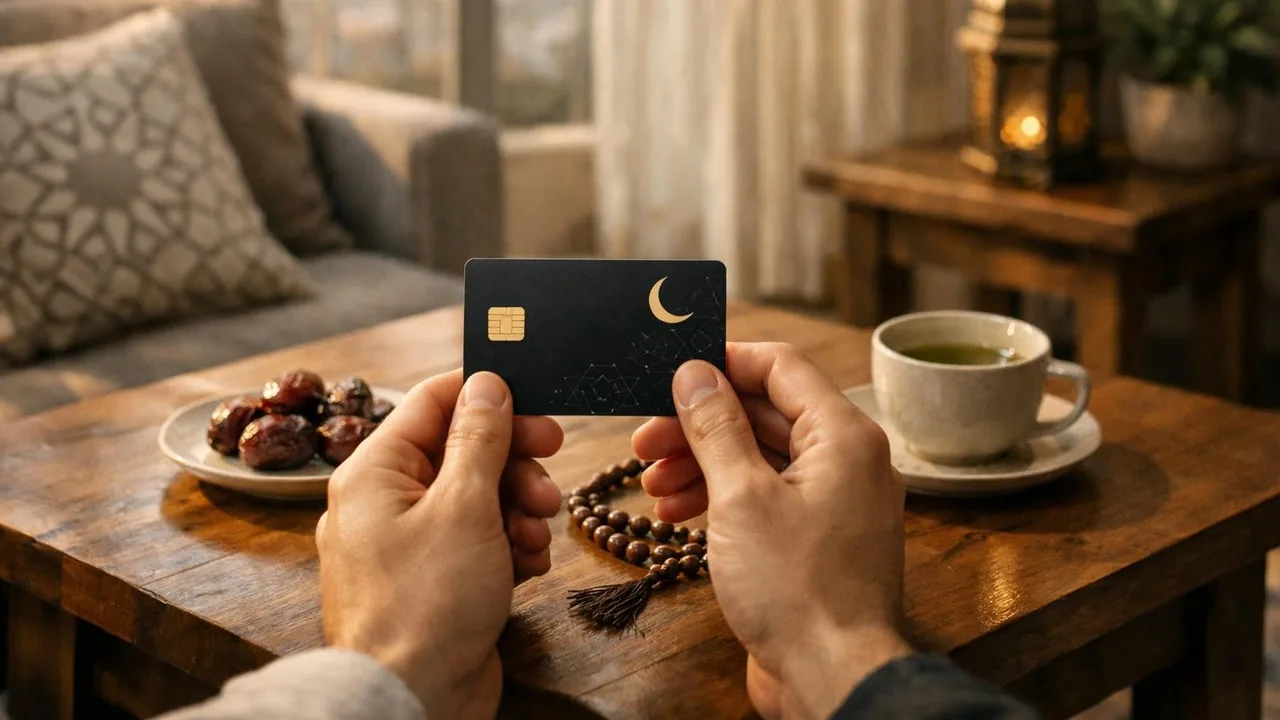
Islamic credit cards in Pakistan are rare. Of the Islamic bank websites we could load on 13 September 2026, HBL Islamic, BankIslami, Al Baraka and Bank Alfalah Islamic list debit cards only. The two issuers known for Shariah-compliant credit cards, Faysal Bank with its Noor Card and Dubai Islamic Bank Pakistan, sit behind sites that could not be fetched today, so their fees and limits are treated here as quote-only. Meezan Bank has historically chosen not to issue a credit card at all. Where an Islamic credit card exists it runs on ujrah, a fixed fee for the card's services, instead of interest on the balance, and any amount collected for late payment goes to charity rather than to the bank.
Ready to compare halal options?
Why a conventional credit card is riba and what ujrah changes
A conventional credit card is a loan with interest that accrues on the unpaid balance by the day. That is riba al-nasiah in its plainest form: more money owed because time has passed. The grace period does not change the contract; it only waives the interest if you pay in full. Our earlier piece on whether credit card use is halal in Pakistan works through the scholarly positions on using a conventional card and paying in full. This article is about the alternative product, the card designed so that no interest exists in the contract.
An ujrah card replaces interest with a fee for services. The bank charges a fixed monthly or annual amount for the card, the payment network access, the statement, the fraud protection and the credit line administration. The fee does not vary with how much you owe or how long you take to pay. The debt itself is a Qard, a benevolent loan the bank must not profit from, which is why the fee has to be justified as the price of services rather than as the price of money. Several Gulf banks run cards this way; the Pakistani cards described by their issuers follow the same logic. The is it halal hub collects the rulings on cards, BNPL and instalments.
Which banks actually offer an Islamic credit card in 2026
We checked each bank's Islamic cards section on 13 September 2026. The table records what the site showed, not what branch staff may say.
| Institution | Islamic credit card on site | What the cards page lists | Status today |
|---|---|---|---|
| HBL Islamic | No | Debit cards: co-badge, World, World Business, Gold, UPI Gold, Classic (Mastercard, Visa, UnionPay), Business, PayPak; deals and discounts | Verified on hbl.com |
| BankIslami | No | Debit cards accepted at over 50,000 merchants and 14,000 ATMs in Pakistan; card discount newsletter | Verified on bankislami.com.pk |
| Al Baraka | No | Debit cards: Mastercard, Platinum Mastercard, UnionPay, PayPak, Aura | Verified on albaraka.com.pk |
| Bank Alfalah Islamic | Not listed on pages fetched | Accounts, Alfa app and debit cards; instant debit card application | Verified on bankalfalah.com |
| Faysal Bank | Noor Card marketed as Shariah-compliant | Could not be loaded | Quote-only, site not reachable |
| Dubai Islamic Bank Pakistan | Islamic credit card marketed | Could not be loaded | Quote-only, site returned an error |
| Meezan Bank | Historically debit-only | Could not be loaded | Quote-only, site not reachable |
The pattern is clear even with three sites down. Pakistan's largest Islamic banking operations have decided that a debit card, often with instalment plans attached at the point of sale, is enough. The Faysal Bank and Dubai Islamic Bank Pakistan profiles describe each bank's governance; both have Shariah boards that have signed off on a card product, and both publish an Islamic schedule of charges that you should read before applying.
How an ujrah card is priced: the fee schedule to read
Because the fee is the whole price, the key fact statement and the Islamic schedule of charges are the documents that matter. Expect to see an annual or monthly card fee, often tiered by card type, sometimes waived if you spend above a threshold; a cash withdrawal fee that must be a flat amount rather than a percentage that grows with time; a foreign currency conversion charge, which is permissible as a spot exchange with a disclosed margin; and fees for supplementary cards, replacements and statements. What you should not see is any charge described as profit, mark-up or finance charge on the outstanding balance.
Two features deserve a hard look. The first is a monthly fee that is only charged when there is an outstanding balance, or that is tiered by balance band. Scholars differ on this; a fee that rises with the debt starts to look like interest with a different label, and the stricter view, including the position taken by several AAOIFI-aligned scholars, is that the fee must be independent of both the amount and the duration of the debt. The second is the instalment plan. Converting a purchase into fixed monthly payments at a stated profit is usually structured as a Murabaha or a fee-based service; ask which, because a Murabaha must name the goods and fix the price at the outset, while a service fee must not scale with the tenor.
Late payment: how the charity clause works
An Islamic bank cannot charge you more because you paid late; that would be riba. What every Islamic financing product in Pakistan does instead, under SBP's Shariah governance framework, is have you undertake at signing to pay a sum to charity if you default on a due date. The bank collects it, but into a charity account supervised by its Shariah Board, not into its income. The same mechanism applies to an Islamic credit card, and the published examples from other products show the range you may meet.
- HBL Islamic's home finance FAQ sets the charity at a flat Rs 1,000 for each late rental, administered under the bank's Shariah Board approved charity policy.
- Bank Alfalah Islamic's home finance key fact statement for July to December 2026 applies charity at 24% a year on the overdue rental value from the due date to the payment date.
- BankIslami's SME financing page states a charity undertaking of 20% a year on amounts paid after the due date, credited to a charity account.
For a card, ask the issuer the exact charity formula, whether it is a flat sum or a rate, and whether it applies to the full balance or only the minimum due. Ask too whether the bank publishes where the charity goes. The clause is legitimate, but a high rate applied to a full balance can cost as much as conventional interest if you fall behind, with the difference that the bank does not keep it. That difference matters in fiqh; it does not help your budget. Treat an Islamic credit card as a payment tool to be cleared in full, not as a borrowing facility.
Is an Islamic credit card halal? The conditions
The majority of contemporary scholars and the Shariah boards of the Pakistani issuers accept a fee-based credit card, subject to conditions. The conditions below are drawn from the published fatawa of standard-setting bodies and from the way Pakistani banks describe their own compliance; where a card fails one, the stricter scholars treat it as impermissible.
- The card fee must be a fixed charge for defined services and must not increase with the balance owed or the time taken to repay.
- No interest, profit or mark-up may be charged on the outstanding balance, including after the grace period.
- Late payment amounts must go to a charity account, not to the bank, and the formula must be disclosed in advance.
- Cash withdrawals must carry only a flat service fee, not a time-based charge.
- The card must not be usable for transactions that are themselves haram, and issuers typically block certain merchant categories.
- Any instalment conversion must be a proper Murabaha with named goods and a fixed price, or a flat fee that does not depend on tenor.
There is also a personal condition that no fatwa can impose: whether you will actually pay in full each month. A card that is compliant on paper still tempts you to spend money you do not have, and a charity clause still hurts. Many pious Pakistanis who could qualify for an ujrah card choose a debit card with an instalment plan instead, and the banks' product menus suggest most Islamic banks agree with them.
Faysal Noor Card and Dubai Islamic: what to ask when you apply
Because we could not load either issuer's site on 13 September 2026, we will not quote fees, limits or eligibility for the Noor Card or for Dubai Islamic's card. Faysal Bank converted its whole balance sheet to Islamic banking and markets the Noor Card as its Shariah-compliant card; Dubai Islamic has long marketed an Islamic credit card in Pakistan. Both will give you a key fact statement on request, and SBP's rules require it before you sign. Take these questions with you.
- What is the exact monthly or annual fee for my card tier, is it waived above a spend threshold, and does it change if I carry a balance?
- Is there any charge of any name on the unpaid balance after the due date, other than the charity amount?
- What is the charity formula, does it apply to the whole balance or the minimum due, and who administers the charity account?
- How is a cash advance charged, and is the charge flat or time-based?
- How are instalment plans structured, and will I receive the Murabaha documents naming the goods and the fixed price?
- Which merchant categories are blocked, and how is a foreign currency transaction converted and charged?
Alternatives if your bank is debit-only
If you bank with HBL Islamic, BankIslami, Al Baraka, Bank Alfalah Islamic or Meezan, you are not missing much. HBL Islamic's World and Gold debit cards and Al Baraka's Platinum Mastercard carry the merchant discounts and lounge access that pull many people towards credit cards, and the Islamic bank accounts hub compares the accounts they sit on. For spreading a large purchase, two halal routes exist. Buy-now-pay-later from a provider holding SECP's Shariah compliance certificate, which our QistBazaar and BNPL analysis examines, and Islamic personal financing from a bank, which BankIslami lists in both unsecured and secured form and which our halal personal financing guide compares.
Both of those are Murabaha or Ijarah structures tied to specific goods with a fixed total cost. That makes them more cumbersome than a card and, for exactly that reason, harder to misuse. For international payments where a card is unavoidable, hotel deposits, software subscriptions, flight bookings, an Islamic debit card on a foreign currency account does the job without a credit line; HBL Islamic issues a debit card on its USD freelancer account, for example.
Our view
A Muslim in Pakistan who wants a credit card for convenience and will clear it every month has two Shariah-approved candidates, Faysal's Noor Card and Dubai Islamic's card, and should choose between them on the published fee schedule and the charity formula, insisting on the key fact statement and confirming that no charge at all attaches to the balance. Anyone who has ever carried a balance on a conventional card should not apply for either, because a charity clause at a double-digit annual rate will discipline the budget no more gently than interest did; a debit card with occasional Murabaha instalments is the safer tool.
Customers of the debit-only Islamic banks lose little by staying put. The deals, the lounge access and the instalment plans now live on debit products, and the absence of a credit card from HBL Islamic, BankIslami, Al Baraka and Bank Alfalah Islamic is a considered position, not a gap. Use our provider comparison to weigh the accounts behind the cards. Facts checked against hbl.com, bankislami.com.pk, albaraka.com.pk, bankalfalah.com on 13 September 2026.
Frequently asked questions
Which banks offer Islamic credit cards in Pakistan?
Faysal Bank markets the Noor Card and Dubai Islamic Bank Pakistan markets an Islamic credit card; neither site could be loaded on 13 September 2026, so their terms are quote-only. HBL Islamic, BankIslami, Al Baraka and Bank Alfalah Islamic listed debit cards only on the pages we verified, and Meezan Bank has historically not issued a credit card.
How does an ujrah credit card make money without interest?
It charges a fixed fee for the card's services, such as network access, statements, fraud protection and administration of the credit line, plus merchant interchange on each transaction. The fee does not depend on how much you owe or for how long. The debt itself is a Qard on which the bank may not profit, which is why the fee must be tied to services rather than to the balance.
What happens if I pay an Islamic credit card late?
You pay a pre-agreed charity amount, which the bank collects into a Shariah Board supervised charity account rather than its own income. The formula varies: examples from other Pakistani Islamic products range from a flat Rs 1,000 per late instalment at HBL Islamic to 20% or 24% a year at BankIslami and Bank Alfalah Islamic. The bank can also suspend the card and report you to eCIB.
Is it halal to use a conventional credit card if I always pay in full?
Scholars differ. Many permit it out of necessity where no Islamic card is available, on the basis that no interest is actually paid, while others object to signing a contract that contains a riba clause at all. Pakistan now has fee-based alternatives from Faysal and Dubai Islamic, which weakens the necessity argument. Our separate analysis of credit card use covers the positions in detail.
Why does Meezan Bank not offer a credit card?
Meezan's site could not be loaded on 13 September 2026, so we cannot quote its current reasoning. Historically the bank has taken the position that a credit card encourages consumption debt and that its Shariah board preferred debit cards and goods-based financing. Confirm the current stance on meezanbank.com; the other large Islamic banks whose sites we did load have reached the same debit-only outcome.
Compare providers in your state
See side-by-side comparisons of Shariah-compliant products, or let our matcher recommend the best options for your situation.
Can I get instalment plans without a credit card?
Yes. Islamic banks offer Murabaha-based personal financing for named goods, BankIslami lists both unsecured and secured Islamic personal finance, and SECP-certified buy-now-pay-later providers such as QistBazaar offer instalments at the point of sale. Each fixes the total price at the outset, which is what makes them compliant and also what makes them harder to overuse than a revolving card.